Would You Rather
- 4.4
- Rating
- 100.00K
- Installs
- Free
- Price

 Analysis by App-foxy
Would You Rather is the kind of trivia game I reach for when I want something social, quick, and easy to explain. There is no complicated tutorial to study: the central activity is choosing between two options, even when neither answer feels completely comfortable. That simplicity makes it useful at a party, during a relaxed evening with friends, or as a casual conversation starter when nobody wants to commit to a longer game.
Developed by Vorens Studios, this free game takes the familiar “would you rather” format and turns it into a repeatable mobile experience. Its appeal is not based on having a correct answer. Instead, it creates small moments of disagreement, surprise, and personality. I found that the most enjoyable part was often the discussion after a choice rather than the tap itself.
The game sits in the trivia category, although it behaves differently from a conventional quiz. You are not testing knowledge, racing against a clock to prove expertise, or memorizing facts. You are revealing preferences. That distinction matters, because it makes the game approachable for people who usually avoid trivia apps.
You May Also Like

 Blood Strike: 2.5 Anniversary
Blood Strike’s Loadouts Turn Every Drop Into a Tactical Gamble
A close look at Blood Strike’s custom loadouts: how fast access to signature weapons reshapes its battle royale rhythm, rewards preparation, and narrows the gap between fights.

 Pandora - Music & Podcasts
Pandora’s Music Is Easy to Start, but Harder to Recover
Pandora’s strength is its low-effort path from a seed to a station. Its weak spot is how much confidence it asks you to place in connection, setup, and quiet recovery.

 8 Ball Pool
 Is Built on Rivalries, Rematches, and Routine
A close look at the rivalries, rematches, shared routines, and unanswered safety questions that turn a quick pool match into a persistent mobile community.

 Samsung Music
’s Quiet Strength Is Playing What You Already Own
Its reach comes less from spectacle than from dependable access to a personal library. That simplicity is both the app’s strongest retention engine and its ceiling.

 AccuWeather: Weather Radar
AccuWeather Review: A Quick, Clear Forecast for Everyday Decisions
For everyday plans, the best forecast is the one you can understand quickly. AccuWeather makes rain timing, radar, and local conditions easy to act on, with a few trade-offs.

 Hill Climb Racing
Why Hill Climb Racing Still Turns Crashes Into One More Run
A tiny car, a bumpy hill and one more upgrade: Hill Climb Racing keeps resurfacing because its simple chaos makes every near-miss feel personal.
More From Our News Desk
View All News


How the first few rounds feel
My first impression was that the game understands the value of a low barrier to entry. The basic premise can be explained in one sentence, so a new player can join without reading a rulebook. That is especially helpful when the phone is being passed around a group and people are more interested in talking than navigating menus.
The free entry point also makes it easy to try without treating the download as a major commitment. The game has passed over one hundred thousand installs and holds a 4.4 average from around one thousand ratings, which suggests that its straightforward format has found a reasonably broad audience. I would not use those figures as proof that every question will suit every group, but they do fit the experience: this is designed as an accessible casual game rather than a specialist challenge.
In a typical evening, one person can read a dilemma aloud, everyone can choose, and the group can immediately ask why someone picked the less popular side. That flow works well because the app does not need to dominate the room. It supplies a prompt, then lets the players create the entertainment themselves.
That same simplicity can feel limited if I play alone for too long. A choice has more energy when another person reacts to it. Solo use is possible as a way to pass a few minutes, but the strongest use case is shared play, either with people in the same room or with friends taking turns around one device.
The Teen content rating is also worth taking seriously. The format can move into awkward, personal, or mature territory depending on the question and the group. I would be comfortable recommending it to older teenagers and adults who understand the tone, but I would not treat it as a universal family game for young children.
A small ritual makes group play better
One practical tip is to establish the order before starting. If everyone simply shouts at once, the loudest player can shape the conversation. I prefer having each person answer silently first, then revealing choices together. That creates more honest reactions and prevents the first opinion from influencing everyone else.
Another useful habit is to allow a short explanation after each round, but not a long debate over every question. The game works best when the pace stays light. If a prompt becomes genuinely uncomfortable, skipping it is more important than preserving a streak or proving a point. The app is a conversation tool, not a test of how much personal information someone owes the group.
The visual language of a choice-based game
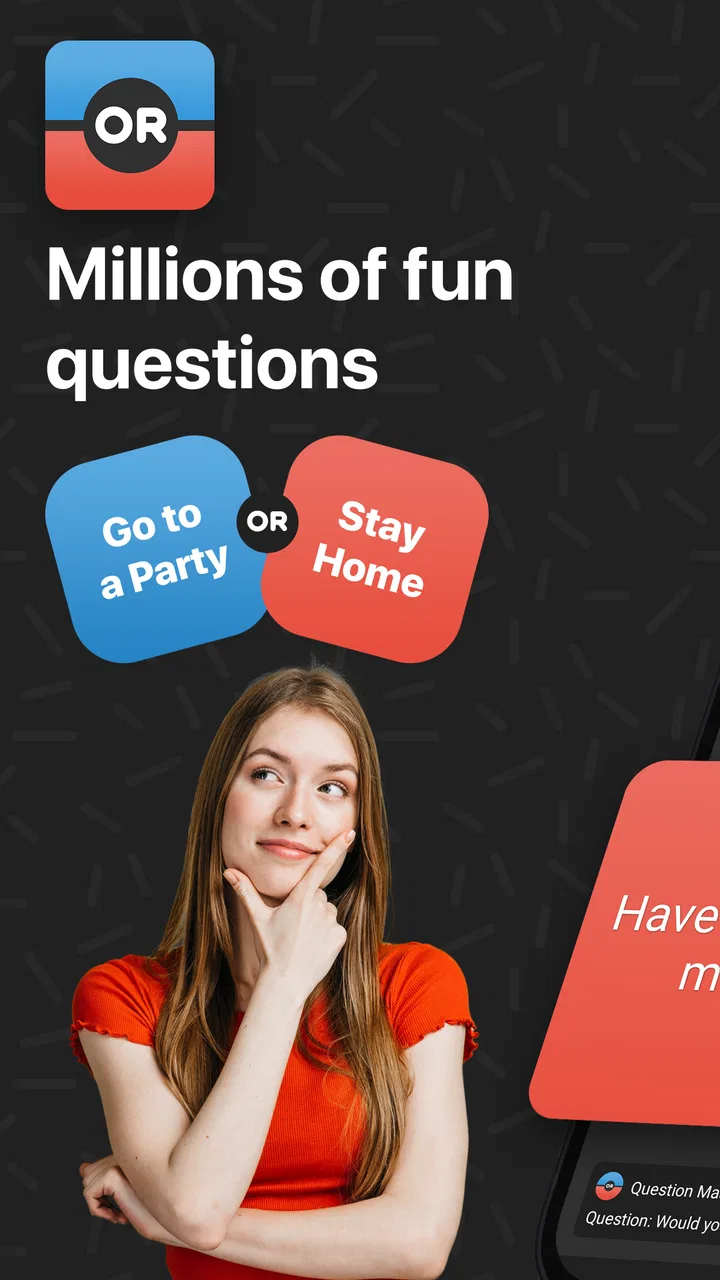
Because this format has no elaborate map, character roster, or campaign world to explore, its setting is created through presentation and context. The app’s identity comes from placing the dilemma at the center of the screen and giving the player a clear moment to decide. That directness supports the game’s social purpose: the words need to remain more important than decorative distractions.
I see the visual approach as functional rather than theatrical. That is not a criticism by itself. A heavily animated interface could slow down the exchange between players, especially when the phone is being passed around. Here, the imagined “world” is the group’s reaction to each prompt. The screen acts like a stage card, while the people around it provide the characters, arguments, and humor.
This also explains why the game can fit different settings. In a living room, it becomes a party prompt. On a journey, it can fill quiet stretches without demanding constant concentration. During a casual online call, one person can read the question and collect responses verbally. The app does not require a specific fictional universe because its setting changes with the company using it.
There is a trade-off in that design. Players looking for rich artwork, a strong narrative setting, or a sense of progression through a detailed world may find the experience visually modest. Someone choosing between this and a story-driven adventure should expect very different rewards. This is about immediate social friction, not exploration.
Why the plain presentation helps the mood
The lack of a complicated setting keeps the emotional focus on the dilemma. A question can be funny, revealing, or mildly uncomfortable without competing with a large amount of interface information. In my experience, that gives the game a conversational mood rather than a competitive one.
Still, the mood depends heavily on the group. With close friends, an absurd choice can become a running joke. With strangers, the same question may feel too personal. I recommend starting with harmless prompts when introducing the game to a new group, then letting the room decide whether it wants more challenging material.
This is one of the less obvious strengths of the format: it can be adjusted socially even when the underlying mechanic stays simple. The players control the atmosphere through their reactions, boundaries, and willingness to explain themselves.
Sound, rhythm, and the space between questions
For this type of game, sound does not need to carry a large fictional world. What matters more is whether audio supports a clean rhythm. A good round should move from reading, to choosing, to reacting, without making the player wait through unnecessary interruptions. The more quickly that loop settles into place, the more natural the conversation feels.
I think of the game’s rhythm as a series of short social beats. The prompt creates anticipation, the choice creates a tiny pause, and the explanation creates the payoff. If players rush through the selection, they lose the chance to notice how differently everyone thinks. If they spend too long on every screen, the energy drops. The ideal pace is quick enough to keep momentum but open enough for conversation.
This is where the game differs from a timed knowledge quiz. In a conventional trivia app, speed can be part of the challenge and a wrong answer ends the exchange. Here, the absence of a right or wrong choice means the pause has another purpose: it lets players imagine the consequences of both options before committing.
That design creates a relaxed kind of tension. I am not worried about losing points, but I may still hesitate because both answers reveal something about me. The game’s mood therefore comes from social anticipation rather than difficulty. It can be playful, thoughtful, or awkward within the same session.
Keeping the rhythm from becoming repetitive
My main concern with extended sessions is repetition. Any game built around one central question format risks feeling predictable once the novelty fades. I would use it in short rounds rather than treating it like a long campaign. Ten minutes can be enough to start a lively discussion, while an uninterrupted marathon may expose the limits of the structure.
A good way to refresh the experience is to change the audience or the rules of discussion. With close friends, ask everyone to justify the less popular answer. With family, keep the conversation practical and age-appropriate. With a group that enjoys debate, give each person a moment to defend the option they did not choose. These variations do not add new software mechanics, but they make the existing prompts work differently.
The game is also useful as a warm-up. If a group is quiet at the beginning of a gathering, a few low-stakes choices can give people something to respond to without forcing formal introductions. I would not use it as a substitute for a full party game with teams, scoring, or a clear winner, but it can bridge the awkward first few minutes effectively.
Where the mechanic fits and where it does not
The core mechanic is intentionally simple: read two possibilities and select one. Its strength is immediate understanding. Its weakness is that it does not offer the layered strategy found in board games, word games, or competitive quiz apps. There is no need to build a deck, manage resources, learn categories, or improve a technical skill.
That makes it a strong choice for mixed groups. A confident trivia player and someone who dislikes factual quizzes can participate on equal terms. Nobody is punished for not knowing a particular subject. The interesting question is not “What is the correct answer?” but “What would you personally accept, sacrifice, or prefer?”
Compared with ordinary trivia apps, this game is less educational and more interpersonal. If I want to learn geography, history, science, or current events, I would choose a conventional quiz instead. Those games provide measurable improvement and clearer feedback. This one is better when the goal is conversation, laughter, or discovering unexpected preferences.
Compared with party games that have scoring systems, it is easier to start but less structured. There is no obvious winner driving the session forward, so the group has to create its own reason to continue. That can be liberating for a relaxed gathering, but it may disappoint players who need competition to stay engaged.
Compared with a random question generator, the dedicated game format feels more purposeful because every prompt belongs to the same recognizable activity. However, the experience still depends on whether the questions match the group’s sense of humor and comfort level. A prompt that works brilliantly with longtime friends may be a poor choice at a workplace gathering.
Three practical ways to get more from it
Use simultaneous answers. Have everyone decide before anyone explains. This reduces peer pressure and makes the reveal more interesting.
Separate funny rounds from serious rounds. Start with harmless choices, then move toward more personal dilemmas only if the group is comfortable. This protects the mood while allowing deeper conversation.
Stop before the format wears out. Ending after a lively exchange is better than continuing until every player is answering automatically. The game benefits from being used as a compact activity rather than an obligation.
There is also a financial consideration. The game is free to download, while optional in-app purchases range from forty-nine cents to ten dollars and ninety-nine cents per item. I would begin with the free experience and only consider spending if the available content and the group’s regular use justify it. Since the central mechanic is easy to understand, paying does not change the basic reason to play; it is more relevant to how much variety or continued use a player wants.
For device compatibility, the listed minimum is Android six point zero. That makes it accessible to many older Android phones, although actual comfort will still depend on screen size, performance, and how easily a group can read the text while passing the device around. I would use a larger screen when several people are playing together, simply because readability affects the pace of the conversation.
Who should choose it
I recommend this game to people who want a low-pressure social activity with almost no learning curve. It is particularly suitable for friends who enjoy debating imaginary situations, couples looking for conversation prompts, and groups that want something lighter than a competitive quiz. It can also help break the silence when people are meeting for the first time, provided the opening questions stay comfortable.
It is less suitable for players who expect a campaign, deep progression, strategic decisions, or a reliable sense of achievement. If your ideal mobile game gives you levels to master, scores to improve, or a world to explore, this may feel too slight. The same is true if you usually play alone and want a substantial solo challenge.
Parents and hosts should also consider the Teen rating before placing it in front of a mixed-age group. The format invites personal answers, so age suitability is not only about the app itself but also about who is present and how the questions are handled. A little preparation—agreeing that anyone may skip a prompt—makes the experience more respectful.
One question many new players have is whether they need trivia knowledge. They do not. The category label may suggest a quiz, but the game’s appeal comes from preference and imagination rather than factual recall. Another common concern is whether there is a single correct answer. There is not; the point is the reasoning and reaction behind the choice.
Players may also wonder whether it works without a large group. In my experience, two people can get value from it, especially if they enjoy comparing priorities. A bigger group creates more varied answers and stronger reveals, but the basic conversation loop does not depend on a crowd.
As for the best session length, I would keep it flexible and relatively short. Use it between other activities, during a wait, or as a warm-up rather than expecting it to replace an entire evening of entertainment. Its strongest moments arrive when a question sparks a story, not when players race through a large number of screens.
A coherent mood built from simple choices
Would You Rather works because its presentation, rhythm, and mechanic point in the same direction. The straightforward visual language keeps attention on the dilemma. The short-turn pacing leaves room for reactions. The absence of right answers changes trivia into a social exchange. None of those elements is ambitious on its own, but together they create a clear, playable mood.
My final view is positive, with realistic expectations. This is not a deep game and it does not try to be one. Its value comes from making people talk with very little setup. The free price makes trying it easy, the Teen rating signals that group context matters, and the optional purchases are best treated as a choice rather than a requirement.
Vorens Studios has built an experience that is most effective when the phone stays in the background and the players take over. I would install it for a gathering, a casual date, a road-trip break, or a quiet evening with friends. I would skip it when I wanted education, competition, or a rich fictional setting. For the right audience, though, the real game begins after the choice: the explanation, the surprise, and the conversation that follows.
FAQs for Would You Rather
01What is 'Would You Rather' and how does it work?
'Would You Rather' is a fun and interactive game where players are presented with two challenging scenarios and must choose which one they would prefer. It’s designed to spark conversation and laughter, making it perfect for parties or casual gatherings. The app offers a variety of categories, ensuring there’s something for everyone.
02Is 'Would You Rather' suitable for all age groups?
While 'Would You Rather' is generally family-friendly, it’s important to note that some questions may be more suitable for older audiences. The app typically includes a mix of light-hearted and thought-provoking scenarios. Parents should review the content if younger children are playing, as some categories may contain mature themes.
03Does 'Would You Rather' require an internet connection to play?
No, 'Would You Rather' can be played offline, making it a convenient option for situations without internet access. However, some features like updates or additional question packs might require an internet connection. This flexibility allows players to enjoy the game anywhere, anytime.
04Are there in-app purchases in 'Would You Rather'?
Yes, 'Would You Rather' includes in-app purchases. While the basic version of the game is free, users can purchase additional categories or remove ads for an enhanced experience. These purchases are optional and not necessary to enjoy the core gameplay, but they do offer added variety.
05Can I play 'Would You Rather' with friends online?
Yes, 'Would You Rather' offers multiplayer options that allow you to challenge friends and family, either in-person or online. This feature enhances the social aspect of the game, making it a great choice for virtual gatherings as well as in-person parties. Simply connect with others and start playing!
Pros
- Engaging and fun questions to ponder.
- Easy-to-use interface for quick play.
- Great for social gatherings and parties.
- Constant updates with new questions.
- Interactive design enhances user experience.
Cons
- Limited customization options for questions.
- Ads can be intrusive during gameplay.
- No offline mode available.
- Lacks a single-player mode.
- Some questions may repeat frequently.

Would You Rather
Gallery